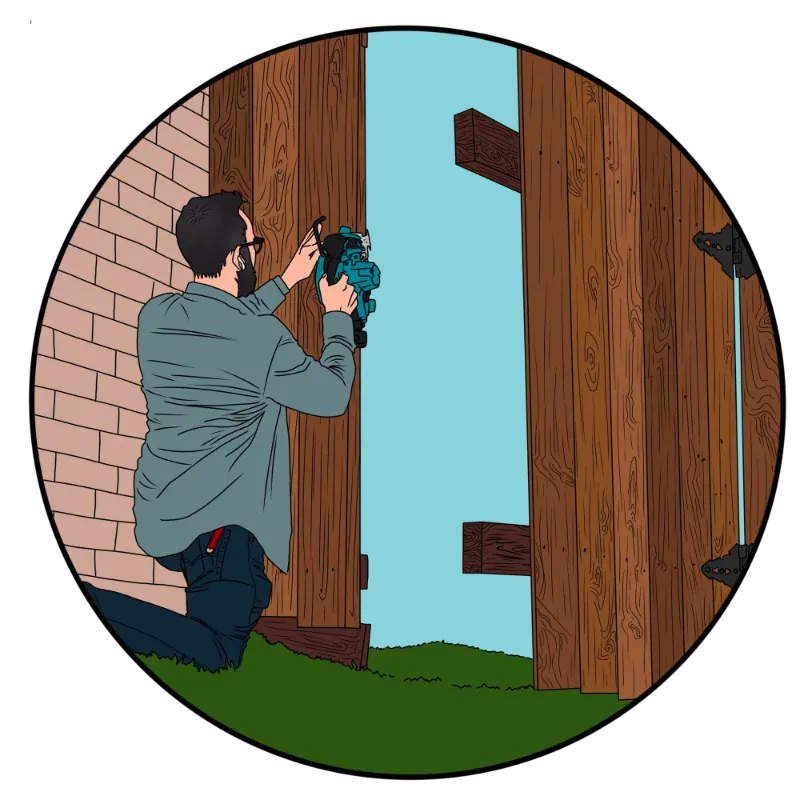
A leaning section does not automatically mean you need a whole new fence. One failed post can be a repair. A long run with failing posts, soft framing, and years of old patchwork is a different story.
In McKinney, we see both. Older neighborhoods near the core may have fences that have been repaired several times over decades. Newer subdivisions can have fences fail early because the posts or framing were light from the start.
The right answer comes from looking at what is still solid, not just counting broken boards.
Start With the Posts
Posts decide whether a fence is worth repairing.
A fence can have ugly pickets and still be structurally sound. It can also look decent from the patio while several posts are rotting or moving at the ground line.
We check each post along the damaged run, not only the one that is leaning the farthest. A screwdriver pressed into a wood post at the soil line can tell you a lot. Soft or crumbling wood means the post has lost strength. Movement at the base usually means the footing or surrounding soil is no longer holding it.
One bad post is often repairable. Several failing posts along the same line can turn a small repair into the first of many.

Look at the Whole Run
The next question is what the rails and boards are attached to.
Older fences around McKinney can be a mix of original material and years of repairs. You may find steel posts next to old wood posts, newer boards attached to soft rails, doubled framing, and sections that have been propped up more than once.
At some point, another patch stops being a repair and starts being a way to postpone replacement.
That does not mean we replace everything just because it is old. We salvage what is structurally sound. But new boards screwed into weak rails will not fix the real problem, and a new rail attached to a rotted post will not stay straight.
Our McKinney fence repair page goes deeper into what we look for on a repair call.
Newer Fences Can Fail Early
McKinney’s newer neighborhoods bring a different kind of repair.
When a fence that is only a few years old starts leaning, age usually is not the reason. We look at post depth, post spacing, concrete footings, and which direction the run moved.
Clay soil swells when it is wet and shrinks when it dries. A shallow post can move a little with every cycle until a hard wind finishes the job.
That is why replacing a few broken pickets may not help when the whole section is already moving from the ground up. If the posts are the failure point, the repair has to start there.
Replacement Fixes More Than Damage
A full replacement gives you a chance to correct problems that a repair cannot.
The old fence comes out, the post line is reset, and the new fence goes back as one system instead of a mix of materials from different years. It is also the time to change the height, board layout, gate position, or material if the old setup no longer works for the yard.
Our standard wood build uses cedar on heavy-duty galvanized steel posts, with the posts set three feet down and six feet apart. A kicker board runs along the bottom to keep the pickets out of the dirt.
If you are already replacing most of a run, rebuilding it correctly once often makes more sense than saving a small amount of old material that will be the weak part of the new fence.
McKinney Rules Depend on the Work
Not every repair is treated the same way as a new fence.
McKinney generally distinguishes between small, like-for-like repairs and projects that change the fence’s height, location, or material. A new fence and a replacement that materially changes the existing fence can trigger permit requirements.
Homes in the Historic Overlay District have another layer to consider. A simple repair that matches what is already there can be treated differently from a change in style, height, or location.
That is one reason we look at the address before giving a final scope. The right repair can depend on where the house is as much as what the fence is doing.
More city-specific information is on our McKinney fence company page.
Repair or Replace: The Short Version
Repair usually makes sense when the problem is contained. One or two failed posts, a storm-damaged section, a bad gate, or a limited run of broken framing can often be rebuilt without touching the rest of the yard.
Replacement starts to make more sense when several posts are failing, the framing is soft across a long section, the fence has already been patched repeatedly, or the old layout no longer works for the property.
The useful question is not, “How old is my fence?” It is, “What is still strong enough to build on?”
We can walk the run with you and show you exactly what we would keep and what we would take out. Call Mom’s Fence Man at 972-561-7555 or request an estimate for a fence repair or replacement in McKinney.


